
Led Astray
When men weaponize the wilderness

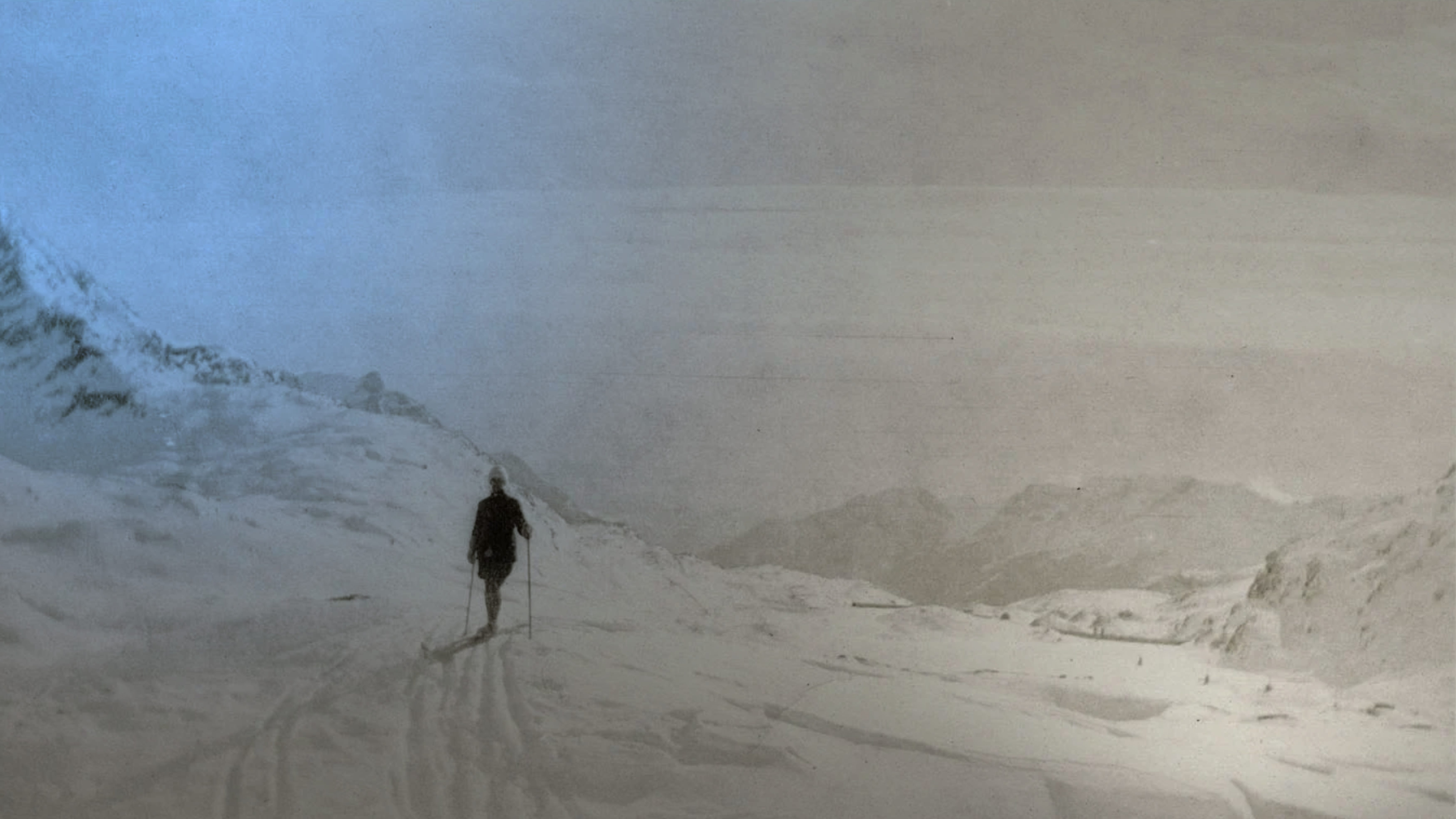
My father almost killed my whole family twice in one year. No, not in an American-style family annihilation by gun. More by accident. And “accident” holds many meanings here.
In 1975, my family; mom, dad, myself, my three sisters, plus the cat before she was executed, lived in a tiny, wooden apartment in the student-housing village of Natland in Bergen, while both our parents were working towards their doctorates at the University of Bergen.
I mention the killing of our beloved family cat by my father, who shot her one night because he was fed up with her suitors stenching up the front porch with their male cat piss - only to acquaint you with my father’s unpredictable temperament. And also to let you know that owning a gun was an exceedingly rare thing for a Scandinavian man at that time, let alone a young father of four, let alone an academic. Nevertheless, my father’s gun was a service weapon he had held on to from his days as a UN peacekeeping soldier in Gaza, some years before he got married to my mother. Not sure how many of our household was aware of this gun, but my mother was certainly acutely aware of my father’s gun.
As is custom in Norway, to the point of almost religiosity, our family spent all our free time out of doors. Hiking, fishing, camping in the warm, light months; skiing, skating and trekking in the cold, dark months. As any Norwegian will attest, we love our mountains, we love our ocean, and we take every opportunity to immerse ourselves in our dramatic lands. In our family, this national pastime was interpreted into a rigorous year-around program run by my very fit, very skilled, and very proud outdoorsman dad.
Now, when my dad first glanced into my mothers eyes and saw his future, I’m certain he saw a gaggle of sons, but alas, what he received was a gaggle of daughters. Thus, on the day of our first almost-demise, my father’s winter mountaineering team consisted of his co-captain, my mother, my eldest sister, 13 years, myself, 11 years, my younger sister, 9 years, and our littlest sister, 3 years. Plus a very large teenage boy from the home for wayward boys where my father worked as a tutor. My childhood saw an endless stream of “problem boys” whom my father took under his wing and then inserted into our family.
Bergen is a small, picturesque coastal city that sits at the bottom of a cauldron of seven mountains, and each weekend year round, families hike, bike, ski, and cable-car up these mountains to “gå på tur”. Most families would take a well-planned, reasonable day trip and be home by dinner time, whereas any outing under my father’s command would be more of an expedition, heavy on ambition and confidence and light on planning and logistics.
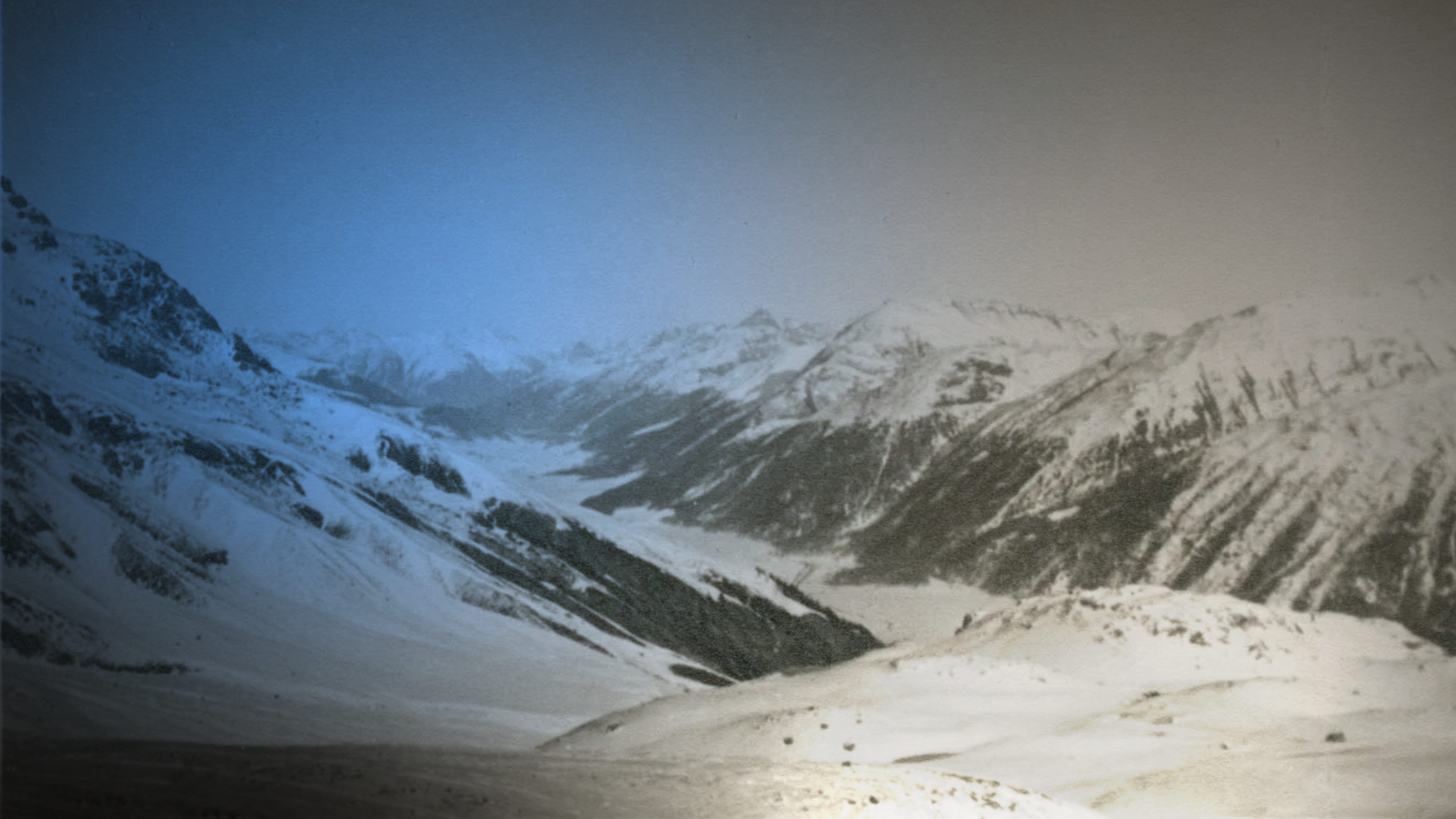
So, this winter day, all seven of us outfitted for a day in the mountains, provisions of hot cocoa and sandwiches in our backpacks, set out first on foot, then cablecar, and once we reached higher altitude and snow, everyone strapped onto skis. Mid-afternoon we made it onto the flat plateau Norwegians call “vidden”, or highlands, that connect some of the mountain peaks.
Having completed the sweaty scramble of getting ourselves to the top, now we could enjoy gliding across the flat, blinding white landscape in single file: dad, the large teenage boy, the three of us older girls, and mom in the rear, harnessed with a sled carrying our baby sister, packed down to her baby cheeks.
Cross country skiing is an endurance sport and while we were hearty and well-trained skiers, going into the late afternoon, our small bodies were feeling the fatigue from the monotonous forward sliding. This time of year the sun would be setting by four-five and I remember watching the yellowing sky, trying to calculate the distance we had traveled against the time it may take to descend from the plateau. I knew better than to ask, lest I’d give my father the impression that I was questioning his leadership - a very risky endeavor. We skied on.
Now, decades removed, I realize that at this stage in my parent’s marriage my mother was an old hand at devising intricate workarounds and strategies to gently steer my father’s impulses, while carefully avoiding triggering his rage, while delicately mitigating his recklessness, while never appearing to take charge. I also now know that ten years and four children in, my mother was exhausted from my father’s track record of poor decision-making, and at a little over thirty years old, she was likely wondering if things were ever going to get easier.
As the sun dipped ever lower, dad finally called for a break and maps and compasses were pulled out. Needless to say, there were no cellphones or a digital world of any kind to consult with. Had we overshot a fork in the trail? Had we not yet reached the turnoff? Do we continue onward or do we turn back and search for a trail we might have missed? A decision was made to keep going, and to look for an off-trail descent if need be.
As dusk thickened, the only person not suffering the chill creeping through our boots and mittens, numbing our hands and feet, was our baby sister packed down in the sled. We would have skied into a blackening night, but blessing of blessings, the moon was full. And because its pale light reflected powerfully off the endless snowy plains, we could see each other and our skis sliding one in front of the other in the amplified moonlight.
The wind picked up, stinging our faces and lowering the temperature further. I don’t remember what I was thinking, if I as an eleven-year old kid understood the gravity of the situation. I doubt I knew the statistics; the number of people who die in the mountains of Norway each year. I now know it’s a small but reliable number. But because I had been brought up on a literary diet of Jack London and Mikkjel Fønhus, I most certainly knew something about what can befall men lost in the mountains. Were we lost on the mountain?
Another stop, another huddle over maps. Not a conversation this time so much as hissing, wild-eyed snorts, swearing and throwing up of hands. The more frantic my father, the calmer my mother. A familiar scenario; dad’s boundless confidence disintegrating and turning into something us kids may have recognized as a temper tantrum, answered by a serene watchfulness emanating from my mother, a heightened awareness, clocking every shift, tending to survival mathematics, deploying her body, herself to temper the growing panic.
Several desperate measures were discussed. Should dad ski ahead to look for the trail? No, he howled, we cannot separate! Should we turn back? No, we’re hours past a possible descending trail! This trail must terminate somewhere! Are we even on an official trail anymore? We had to move our bodies or freeze. Forward.
Suddenly a jagged rock formation rose up before us and dad skied ahead. Moments later he yelled back that he had found a ravine. While this was decidedly not an official trail, my parents decided we must try to climb down this very steep ravine. We didn’t know where it led, only that it led downwards. Skis came off and while mom and dad hoisted the sled with the baby down from rock ledge to rock ledge, the three of us older girls began to clamber and slide down the icy cliffs, not knowing what lay below each slippery edge. We whimpered in fear as we descended.
Balancing on a sheet of ice between two boulders, suddenly my foot went through the ice and I shlooped down through the ice up to my waist. Dad had me by the shoulder before I went down through, and yanked me up and out of the hole. Rock by jag, kid by kid, we kept climbing downwards.
Sliding through so much wet snow, our layers of clothes were getting soppy down to the skin - another escalating danger. Our faces and hands were turning blue, our bodies going into shock, hypothermia. Dad started to cry, wailing and sobbing, pleading for our forgiveness, for getting us into such peril. Self-flagellating, why did he never learn from his mistakes?
While dad was weeping and howling, mom issued quiet directives and gentle encouragements, where to put our feet and hands, grab onto that, step onto this, just a little further, hang in there, we are going to make it down from the mountain, we will be home before we know it.
We climbed for hours in the moonlight. Finally we could make out a flat landscape below, we must be reaching the bottom. But as we neared this flat field, we realized we were headed down onto a frozen lake, not solid ground. The ravine we had been climbing down ended in a lake. No roads, no beach, no alternative paths. We had no choice but to venture out on the ice and chance that the ice would hold as we crossed.
The ice was nowhere near solid, and creaked and cracked as soon as we set foot on it. It was decided we would slide on our bellies one at a time, with the large boy going first, because if the ice held for him it would hold for any of us. Crying from dread, the boy laid his huge body down on the ice and began to snake outwards on the lake. The ice sent out zigzagging cracks in every direction from his body, and we watched in horror, fully expecting to see him plunge through the ice at any moment. But he didn’t, and the ice held, so each one of us girls slid out on the shiny black path the boy had made, belly-snaking across the lake one at a time. After us came dad, pushing the baby sled ahead of him, and last mom.
Meter by meter, we made it across what must have been a few hundred, and finally crawled ashore into a frozen field. We had no idea where we were or if help was anywhere. With our bodies in deepening hypothermia, especially us kids, we were in dire straits and our parents knew it. We must have looked like the living dead as we stalked across the field and onto a country road. This late at night there was not a soul in sight, but as we stumbled down the frozen road, in the far distance we saw a pair of faintly glowing windows. Too in shock to speak, we all fixated on those windows and willed our frozen limbs to move in their direction. If we made it to those windows, maybe we would live.
My memories of what happened after we reached the house are vague. I do remember being put in a cold bath with all my clothes on, and that the water felt like fire. I remember being told that this was the only way to slowly bring me out of hypothermia without putting my body into further shock. I remember old, knowing hands rubbing my feet and hands and legs and arms, slowly massaging me out of my frozen state. Eventually I was able to speak, and then stand, and then drink something warm, wrapped up in thick blankets.
I do also remember my father getting re-animated and trying to explain to these kindly and concerned strangers how in the world we had ended up in this situation. I listened and watched him re-enact the most terrifying experience of my life, transforming the harrowing events into a tale of bravery and derring-do. Gone were the desperate pleas to the universe to take him and save us, begging for my mother’s forgiveness that he had once again imperiled her children, whimpering that he deserved death for what he was putting us through.
The second time our father almost killed us was on the ocean, in the spring following our near-deaths on the mountain that winter. Our parents had rented a small fishing cabin up the coast from Bergen to spend a cozy weekend with kid-friendly fishing trips, maybe hauling a bit of cod and mackerel out of the sea. Again, as was typical for Norwegian kids of this era, us girls were skilled fishers and with our parent’s supervision could handle our poles and lines, baiting and casting, even gutting and processing our catch.
The cabin came with a small wooden rowboat and on the day of our second-near-demise, mom, dad, the three older girls and our baby sister loaded into the boat at the village dock along with our fishing gear, coolers, bait buckets and provisions. It was a gusty spring day, but the dock was nestled inside a small archipelago of rocky holms that shielded us from the open ocean.
Once each of us were settled in positions that held the boat balanced in the water, my father rowed us away from the dock and into the middle of the small bay. That is where we should have stayed considering we had four small children in the boat, but this was too tame of an expedition for my father and he argued that if we wanted to catch real fish, we needed to make our way out on deeper water, out of this lame bay.
So, against my mother’s protestations, my dad headed for a small opening between two rocky isles. As he navigated our little boat through the narrow passage, a familiar tension spread inside the boat. A frozen watchfulness, eyes darting back and forth between our parents; dad confidently leading the charge, mom’s heightened alertness, her eyes sinking back to scan all directions for whatever threats the world held.
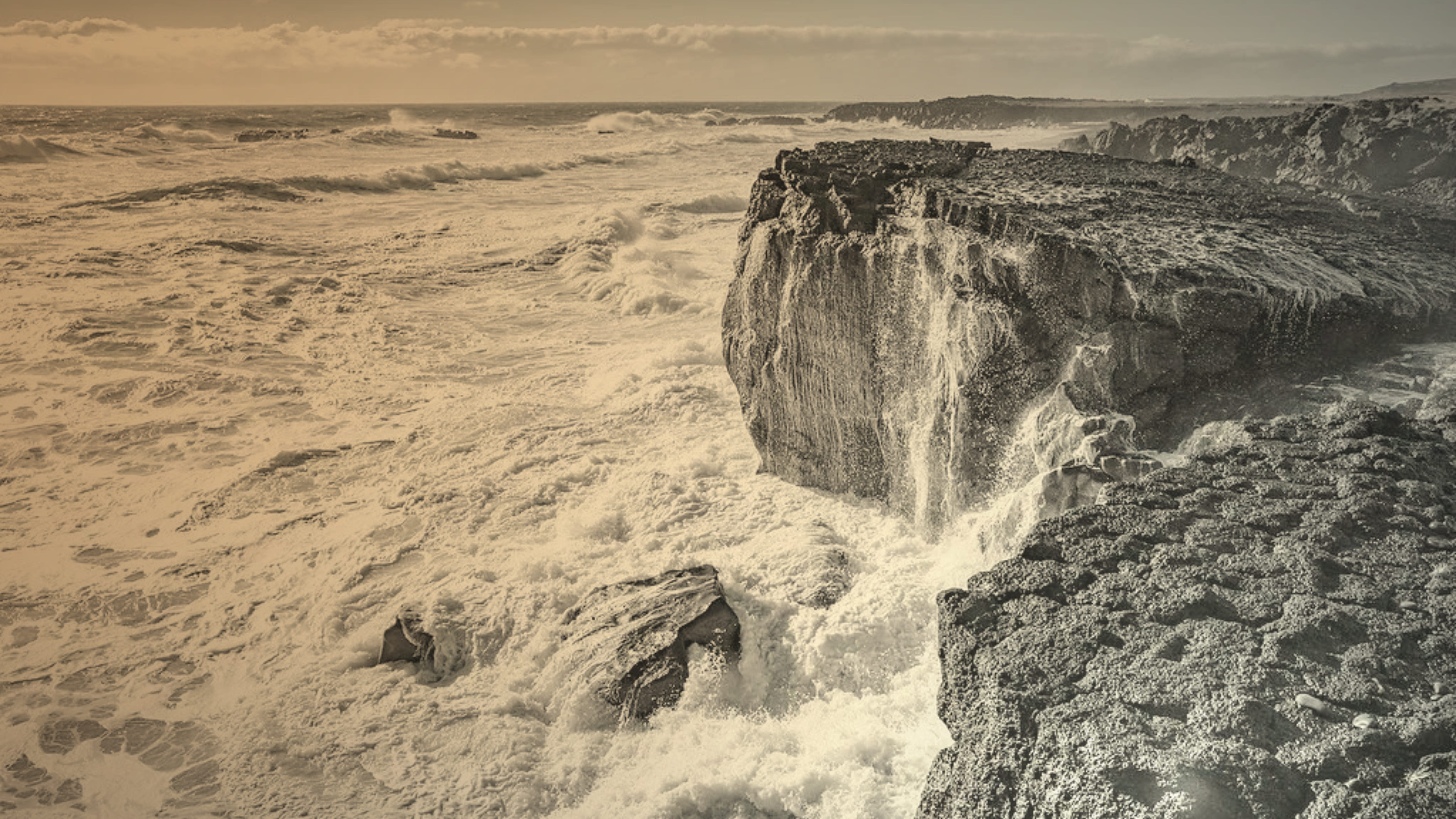
And then we were spat out of the narrow passage into the North Sea, a vast, swelling, roiling ocean throwing itself against the outer cliffs from where we had just emerged.
My mother knew the trouble we were in instantly, but my father, adrenalized by so suddenly coming face to face with such force, became giddy and giggly upon discovering that his little oars couldn’t do much in the way of moving the boat.
Mom commanded all four children to get down in the bottom of the boat, and watched as our father muscled the oars with all his strength to stop us from getting taken by the violent ocean and thrown against the rocks we had just rounded. With each swell we were getting sucked toward the cliff sides, where the ocean exploded against the rocks sending masses of water high above our heads. We had to move the boat outward toward the open water to avoid getting thrown against the rocks, which would have splintered the rowboat to smithereens and us with it.
No matter how hard my father rowed, he couldn’t move the boat out of the suck and the pull, we couldn’t get clear of the maelstrom. Every time we thought we were getting on the ocean side of the break, another wave carried us back in.
My father was getting exhausted, and as we had seen many times before, his mind gave out long before his body. Crying out in headless panic, engulfed in shame, screaming to my mother that we’re not going to make it, we’re all going to die, this is all my fault.
We were being tossed around ever more mercilessly and it was only a matter of time before one big breaker was going to carry us in and smash us to bits. My mother begged for my father to let her take the oars, which he finally, reluctantly let her. Once the oars were in hand, she wasted no time fretting, but set to work with the same calm with which she kneaded dough in the kitchen. Heaving her whole body’s weight against the oars again and again, willing our vessel with her whole soul, she inched the boat away from the deadly rocks.
With my father lying in the bottom of the boat, hands covering his face, sobbing like a child, my mother kept rowing and managed to maneuver us into a small cove. In between waves, she landed the boat in a crevice. She jumped up on land, holding on to the boat, then commanded us one by one to climb out and onto the cliffs, then scramble away from the squalls.
Trembling and much diminished, my father made it on to the rocks last, almost in disbelief that we were still in the land of the living, and with the dawning realization that he yet again had been rescued by my much braver and more capable mother. And that we, the children, had been witnesses to yet another humiliation delivered onto him by that primordial mother that rules us all.
But now we were stranded on a rock in the sea. And again, while my father sat pouting and licking his wounded pride, my mother found a way to pull the boat around the little island all the way to its lee side and found a landing where we could climb back in. All on board, she rowed us back to the dock and to safety.
These close brushes with mortal danger were only two the most memorable examples of my father’s reckless miscalculations. My childhood was peppered with smaller, less story-worthy events, where the stakes were less than life or death. There were many more terrible judgment calls and ill-advised adventures that put us in terrible situations. There were many more grand ideas that came at a great cost - loss of face, loss of trust, loss of money. Rarely did a plan actually come together. Rarely did the glorious picture he painted actually materialize. Rarely was reality as magical as what he had made us believe. And mostly my mother stepped in to close the gap between his imagination and the inevitable work it took to achieve anything.
Both my parents are gone from this earth, and it is only now, decades hence, that I am thinking more deeply about these events and questioning what was going on with my father, why he behaved the way he did.
But it wasn’t until I came across journalist Mel Hamlett’s articles and TikTok videos that I realized that my father was not at all unique. In fact, apparently the world is full of over-confident and dangerously reckless men; family men, dads with children who drag their families out in the wilderness, take headless risks and in too many instances kill their families as a result.
As Mel tells it, she came into close contact with these men during her years as a wilderness adventure guide and whitewater raft instructor in places like Colorado and Wyoming, and took notes on the differences between how women and men behaved on her expeditions. “The biggest threat in my boat wasn’t the whitewater, it was the men in the boat, because they always thought they knew more than me.”1 Men who were determined to be in charge, and who consistently over-estimated their skills. “They always tried to steer the boat by doing c-strokes in the front, a guy who has no experience, just assumes he’s so much better at it. So I’m fighting with some dude who doesn’t know anything.”2
These dangerous behaviors were so prominent that Mel had to learn how to clock these types of men quickly and then prevent them from hijacking her operations, and to force them to listen and to comply with her directives. She had to develop a host of safeguarding strategies to limit the risk these men posed to her groups by their over-confidence, lack of self-awareness, and poor judgement. And now, as a content creator, she writes and speaks about her experiences in the wilderness as cautionary tales to women and children, and of course to other men, to become aware of how easily and blindly we follow men who appear confident and competent. “We have been socially conditioned to trust men as leaders.”3
Mel tells many harrowing stories from her experiences in the great outdoors, and also highlights stories in the media where the reporting fails to hold men accountable. She says “as a raft guide, one of the hardest things to do was to keep the entire boat safe from the men in the boat. These men might be girl dads, or love empowered women, but they won’t respect or listen to the woman who’s literally keeping their families alive, who knows the river.”4 How men, on an adrenaline high, would ignore all directions and precautions, seemed to forget their wives and children, and routinely imperiled everyone onboard. How she began putting women in the front to do the paddling because the women listened, and putting the men in the back with her so she could control them better.
Mel emphasizes how male socialization and female socialization combines to put women at risk. “Men have been raised to do what they want without thinking about the impact, especially when it comes to women and children, because they believe they are dominant over us. Why would they care if women don’t want to flip the raft, why would their opinions matter?”5
She also emphasizes that it isn’t necessarily with bad intent that men lead you into danger. “I talk about this so much because it’s not only abusive men who do this, or toxically masculine men. Even if they’re not intentionally doing it, so many men will invite you to do things that are actually quite dangerous, and you may have no experience in it.”6
Sometimes it’s just poor risk management outweighed by a lust for adventure. “Even if they know it’s a bad idea, they just want to have fun. And fun is always going to trump safety.”7 “Men are socially conditioned to be utterly over-confident, selfish and not respect human life, and then they get in over their head, and are often too proud to admit that, and sometimes women get killed.”8
But in many videos Mel talks about darker motives, “sometimes men take women into the wilderness to humble them, to put them in danger, and then be the hero that saves them”9 (or sometimes just themselves, as it turns out), referring to recent media stories of ill-fated hikes where women or children have been left to die on the mountain, or have “fallen” out of the dingy at sea.
She says that every time she posts a video on this subject, she gets hundreds of women who have nearly died or who have lost someone due to a man’s hubris, recklessness, selfishness, or even intentional violence.
In some instances, men who are facing a divorce they don’t want, who may be suicidal, or despairing in some other way - may use a trip into the wilderness as a means to commit familicide or femicide. Mel says “I like the term ‘wilderness violence’ because there are so many women and children who get harmed by the violence of the wilderness because men put them in those positions on purpose. It’s calculated a lot of times.”10
I think about this, “it’s calculated a lot of times.”
I rewind my childhood back to the time of our near-fatal adventures. I think about what I now know about the status of my parent’s relationship at that time. About the fact that my mother had begun plotting a way out of the marriage. The fact that she was studying toward a degree that would enable her to get a position that would pay her enough to leave my father and to raise us kids on her own. We didn’t know her exact plans at the time, but we all felt her growing defiance, and saw our father’s despairing rage when he couldn’t keep her from drifting away. There were late-night storms in the house. There were strange absences.
Did my father want to scare my mother into submission? Did he want to show her he might take us all out with him if she made the wrong move? Was my father suicidal?
My father was a charismatic man, a charmer, but also a deeply insecure Strindbergian brooder with histrionic mood swings (apparently catnip to women, who flocked to him like moths to a flame, eyelashes aflutter, but alas he was singularly obsessed with my mother). I’m sure the danger he emoted was the very thing that had attracted my mother to him when she was a teenage rebel and herself a wild adventurer - but once she had her children, all that dancing on the razor’s edge turned into a liability she was less and less interested in.
Even with children added, he refused to mature, and she was forced to become the responsible one in the family. As he clung to adolescence - easily bored, always seeking excitement, not in control of his impulses - my mother began to treat him as a child, as one of us. But of course he wasn’t a child, he was a man. A man who commanded respect, who had authority, who towered over us all, who saw himself as the undisputed head of our family. Who had the final say-so in any matter.
Mel Hamlett has an apt term for this kind of man: King Baby. A King Baby is a man who has been given the top spot of his own little hierarchy of wife and children, a coterie of loyal and obedient dependents, whose care and labor he is the main beneficiary of. A King Baby commands the authority of a despot while behaving like a spoiled toddler - so accustomed to getting his every whim satisfied, that should his family fail to deliver what he feels entitled to - hell rains down.
Who had imbued my father with such a sense of entitlement? What had made him so deeply inconsiderate? What had made him so self-centered, so arrogant? The answer I know lies in each generation of men and women who were paired up in the double helix that finally produced my father, but I needn’t look farther back than my grandfather, who kept a wooden spoon handy to smack my grandmother with whenever she displeased him. My kindly, near-mute grandmother who moved around the house like a shy shadow, forever in fear of raising his ire.
The four of us survived our childhood, but my father’s lack of restraint and poor judgement forced my mother to become a buffer between him and us, constantly having to mitigate, placate, pacify - an exhausting position that drained her of all affection. The stress and tension my father produced marked us as well, made us anxious and hyper vigilant. We were all bedwetters, and developed a variety of psychological copes over the years. My older sister buried herself in books and became antisocial, my younger sister sought refuge in the families of friends, I developed a lot of self-soothing tics. None of us thrived.
It took several years for my mother to line up conditions that would allow her to divorce, but then finally, the thing my father dreaded more than anything, happened. The divorce was a catastrophe for my father, but for the rest of us, we could finally let go of that tiger’s tail that would not stop swinging us around and around.
Hamlett, Mel, talking about how men in the wilderness regularly endanger women and children. Tiktok (February 27, 2026)
Hamlett, Mel, talking about how men in the wilderness regularly endanger women and children. Tiktok (February 27, 2026)
Hamlett, Mel, talking about wilderness violence. Tiktok, December 6, 2025
Hamlett, Mel talking about how men’s overconfidence gets women killed all the time. Tiktok, May 25, 2023
Hamlett, Mel talking about how men’s overconfidence gets women killed all the time. Tiktok, May 25, 2023
Hamlett, Mel, talking about wilderness violence. Tiktok, December 6, 2025
Hamlett, Mel talking about how men’s overconfidence gets women killed all the time. Tiktok, May 25, 2023
Hamlett, Mel, talking about wilderness violence. Tiktok, December 6, 2025
Hamlett, Mel, talking about wilderness violence. Tiktok, December 6, 2025
Hamlett, Mel, talking about wilderness violence. Tiktok, December 6, 2025
King Baby. Wow. Outstanding read. I'm glad you survived your King Baby father's irresponsible escapades. I hope everyone in the family was able to heal.
Honestly, I couldn’t finish reading this. The anger had towards your father. He’s getting my blood boiling. And even though your mother was a warrior, she shouldn’t have had to be. She should’ve just left him. He sounds so miserable and so difficult to have lived with